Vital signs amid motion and blocked signal paths
Breathing and heartbeat produce subtle signals within radar reflections. In an occupied room, those signals mix with body movement, changing orientation, furniture, and multipath. A single sensing view can lose useful information when a person turns away or an obstacle blocks the path.
MEDUSA develops contactless vital-sign sensing for these changing indoor conditions. Distributed radar arrays capture complementary spatial views as people move and signal paths change.
Distributed, wirelessly synchronized UWB MIMO
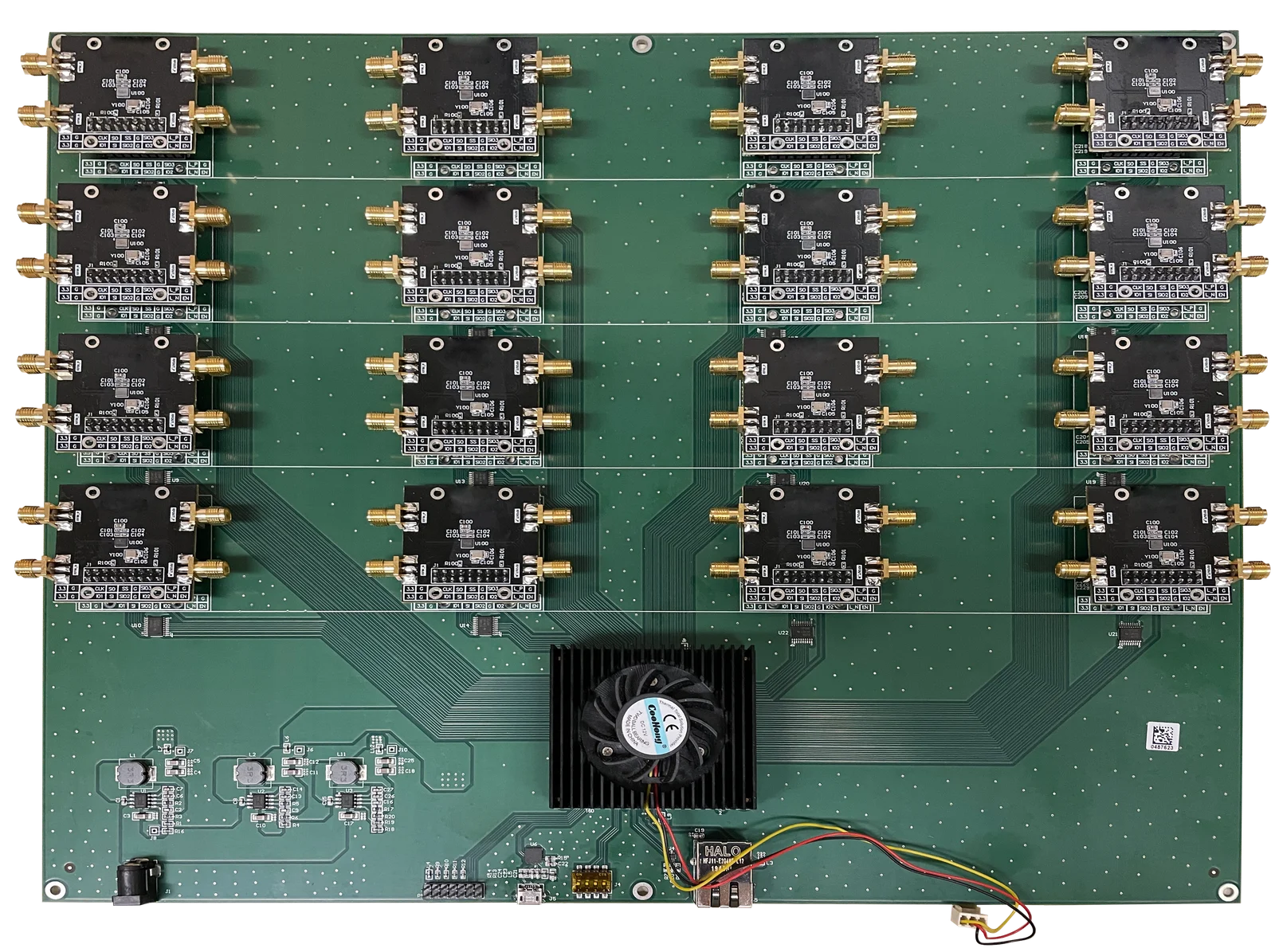
The hardware supports a coherent UWB MIMO array that can be divided into spatially distributed sub-arrays. Wireless synchronization lets the system coordinate those views, while the hardware and data-processing pipeline support collection and processing of the multi-antenna signals.
The design balances antenna gain against spatial diversity. Concentrating antennas strengthens one view; distributing them provides alternatives when a view is obstructed or poorly aligned. Array placement and partitioning are therefore part of the sensing design.
Recovering physiological signals across views
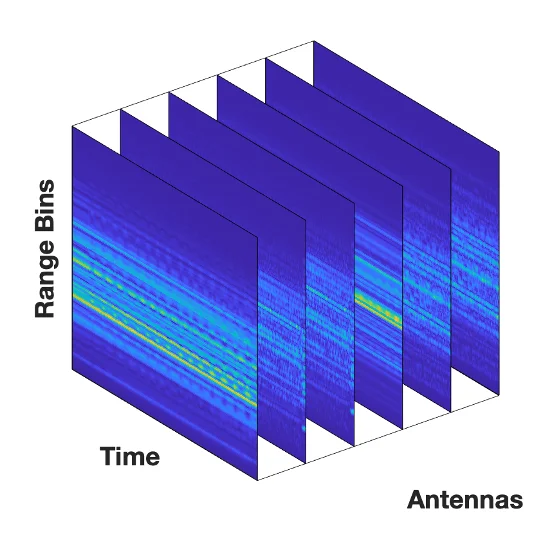
The learning system uses self-supervised contrastive learning and multi-head attention to separate vital-sign waveforms from mixed radar returns. Attention relates to transmit-receive antenna pairs, allowing the model to combine spatial information instead of treating every channel as equally useful.
Distributed measurements provide spatial diversity, and the model recovers the weaker physiological component amid movement and environmental reflections. Hardware, synchronization, and learned signal extraction work together to turn multi-view radar returns into vital-sign waveforms.
Multi-view sensing in everyday environments
The evaluation spans stationary and moving participants, varying locations and orientations, obstructed paths, multiple subjects, and familiar and unfamiliar indoor environments. The findings show how spatial diversity sustains vital-sign sensing when individual views become unreliable.
MEDUSA connects distributed RF hardware to a learning system designed for dynamic indoor sensing. The work highlights the joint importance of array geometry, coherent synchronization, and multi-view signal extraction when recovering subtle physiological motion.
Read the paper abstract
Radar-based techniques for detecting vital signs have shown promise for continuous contactless vital sign sensing and healthcare applications. However, real-world indoor environments face significant challenges for existing vital sign monitoring systems. These include signal blockage in non-line-of-sight (NLOS) situations, movement of human subjects, and alterations in location and orientation. Additionally, these existing systems failed to address the challenge of tracking multiple targets simultaneously. To overcome these challenges, we present MEDUSA, a novel coherent ultra-wideband (UWB) based distributed multiple-input multiple-output (MIMO) radar system, especially it allows users to customize and disperse the 16×16 into sub-arrays. MEDUSA takes advantage of the diversity benefits of distributed yet wirelessly synchronized MIMO arrays to enable robust vital sign monitoring in real-world and daily living environments where human targets are moving and surrounded by obstacles. We've developed a scalable, self-supervised contrastive learning model which integrates seamlessly with our hardware platform. Each attention weight within the model corresponds to a specific antenna pair of Tx and Rx. The model proficiently recovers accurate vital sign waveforms by decomposing and correlating the mixed received signals, including comprising human motion, mobility, noise, and vital signs. Through extensive evaluations involving 21 participants and over 200 hours of collected data (3.75 TB in total, with 1.89 TB for static subjects and 1.86 TB for moving subjects), MEDUSA's performance has been validated, showing an average gain of 20% compared to existing systems employing COTS radar sensors. This demonstrates MEDUSA's spatial diversity gain for real-world vital sign monitoring, encompassing target and environmental dynamics in familiar and unfamiliar indoor environments.