Repeated attempts can repeat the same mistake
For code generation, pass@K asks whether at least one of K attempts succeeds. Independent samples can spend that budget on nearly identical reasoning paths, offering little additional coverage when the dominant strategy fails.
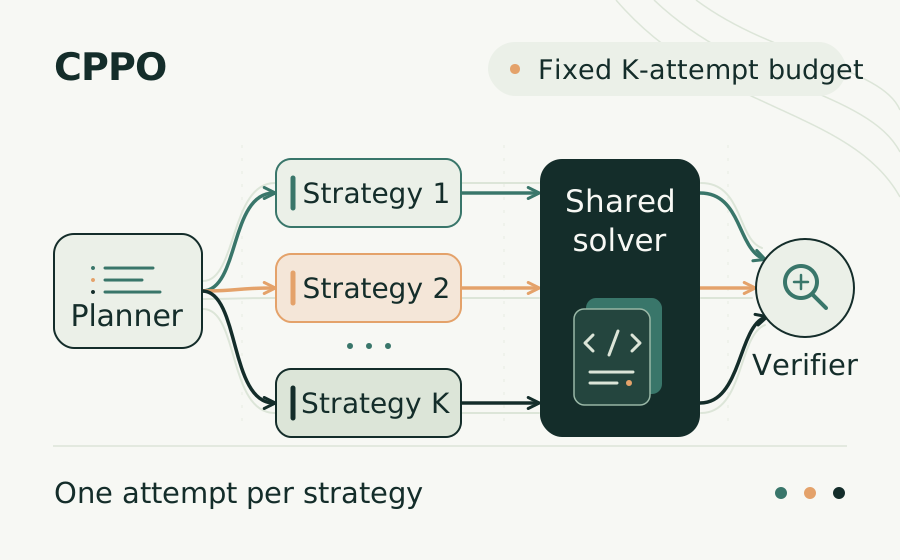
CPPO treats the attempts as a coordinated set. A planner distributes the available attempts across complementary algorithmic methods, making strategy exploration part of the policy.
A planner, a shared solver, and two checks
A planner generates a tuple of alternative high-level methods; a shared solver attempts one implementation per method. Later plans condition on earlier plans, so the policy can coordinate exploration across the tuple.
A learned validity gate checks the strategy tuple, while an execution verifier checks solver outcomes. The multiplicative planner reward combines these signals: the planner receives credit when a valid tuple produces at least one passing solution.
Better coverage at a matched attempt budget
The paper reports improved pass@4 on APPS, CodeContests, and LiveCodeBench-v6 compared with direct sampling, planning baselines, planner-only supervised fine-tuning, and pass@K-oriented reinforcement learning.
With the solver-attempt budget held fixed, the results show the value of coordinating how those attempts explore the problem. Joint planner-solver training turns a collection of samples into a strategy-level search policy.
Learning to allocate reasoning effort
CPPO connects test-time exploration to post-training. The planner learns which sets of methods give the solver useful alternatives, while branch-level verifier feedback trains the solver to execute those methods.
The contribution is a way to allocate a finite reasoning budget on verifiable programming tasks. It makes complementary strategies, plan validity, and execution outcomes part of one coordinated learning objective.
Read the paper abstract
Repeated sampling with a verifier is a standard way to allocate test-time compute for code generation, but drawing K independent samples from one answer distribution often wastes the pass@K budget on near-duplicate reasoning paths.
This paper introduces Coordinated Pass@K Policy Optimization (CPPO), which turns pass@K generation into joint exploration over strategies. A planner emits a tuple of alternative high-level methods, and a shared solver attempts one solution per method. CPPO trains this joint planner-solver policy with a multiplicative planner reward that gives credit only when valid strategy tuples lead to verifier-confirmed pass@K success.
Across APPS, CodeContests, and LiveCodeBench-v6, CPPO improves pass@4 over direct sampling, planning baselines, planner-only SFT, and pass@K-oriented reinforcement learning under the same solver-attempt budget.